
Custom Jewelry Manufacturing: Materials, Plating and Packaging
A private label order is three specifications in one: the base material, the plating stack over it, and the packaging it arrives in. The published options are three base metals — 925 sterling silver, brass and stainless steel — four finishes, and five packaging items, on minimums of 50, 100 and 100+ pieces per design.

Key takeaways
- Floors are 100+ in stainless, 100 units in artisan eco-brass and 50 units in sterling silver, by design quoted per design.
- Finish options are gold in 14K, 18K and 24K with rhodium, protected by silver and brass sealed with anti-tarnish e-coating and PVD on stainless steel.
- Five packaging items are listed, from metallic logo tags to barcode labelling.
- Hallmarks the S925 hallmark, a 316L mark on steel and 18KGP on gold-plated work identify the base and the plating on the finished piece.
Three base materials, and what each one is for
Silver is the material for designs that carry their own value, which is why it also has the lowest entry point at 50 pieces per design. Brass is the material for plated fashion work: it takes the plating stack well and the surface does the selling, at 100 pieces per design.
Stainless steel is the material for pieces that have to survive water, sweat and daily wear, and it is quoted at 100+ pieces per design. All three run through the same eight factory steps, from concept design to the 100% final inspection and delivery.
Plating: one stack for silver and brass, another for steel
Silver and brass are finished with multi-layer precious-metal electroplating — 14K, 18K or 24K gold, or rhodium — followed by a protective anti-tarnish e-coating. That coating is what stops a plated surface dulling in a display case, and it belongs on the specification rather than in the product description.
Stainless steel takes a different route: PVD vacuum plating, applied in a vacuum rather than a tank. It is the reason the steel minimum is the highest of the three, and the reason a range that mixes steel and brass usually ends up with two finish specifications rather than one.
| Base material | Minimum per design | Plating route | Best fit |
|---|---|---|---|
| 925 sterling silver | 50 pcs | Multi-layer gold or rhodium with anti-tarnish e-coating | Precious-metal designs at a low first-run commitment |
| Artisan eco-brass | 100 pcs | Multi-layer gold or rhodium with anti-tarnish e-coating | Plated fashion ranges where the finish carries the look |
| Stainless steel | 100+ pcs | PVD vacuum plating | Pieces worn continuously, in water and in heat |
Packaging is part of the product, not the tail of the order
The published packaging set is five items: foil-stamped gift boxes, display backing cards, logo tags in metal, pouches in velvet or microfiber and barcode labels. Two of those five — the backing card and the barcode — are frequently retailer requirements rather than styling choices, so they change what a carton has to be, not just how it looks.
That is the practical reason to order packaging alongside the piece. A private label jewelry manufacturer that quotes both in the same conversation produces a finished unit rather than a batch of pieces waiting for a box, and the final step of the process includes both the inspection and the packing.
Worked example: reading the minimums as ratios
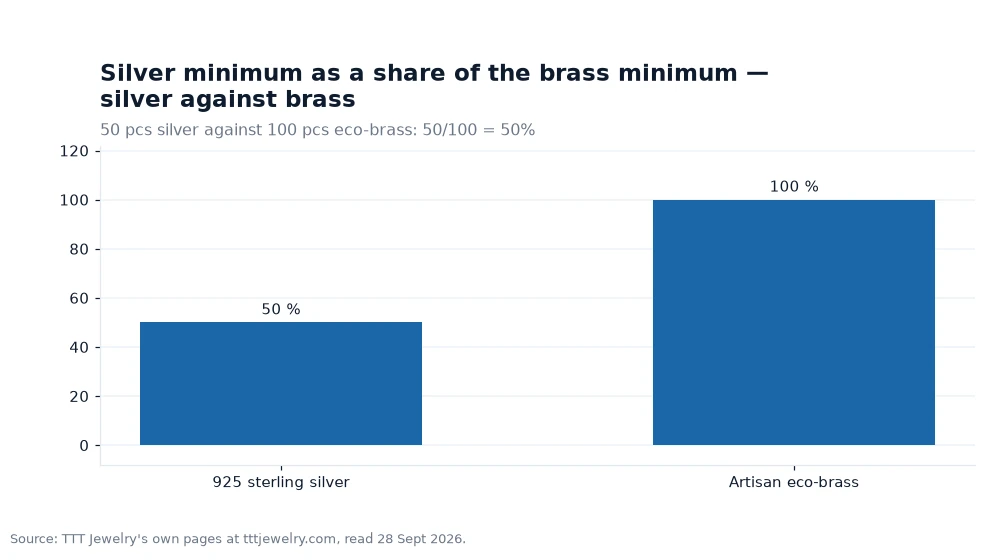
Compare the entry points as shares of each other. Silver at 50 pieces against brass at 100 gives 50 ÷ 100 = 0.5, so the silver minimum is half the brass minimum for the same design. Brass against steel at 100+ gives 100 ÷ 100 = 1, which is the point of the plus sign: steel begins where brass ends and usually goes higher.
Those ratios are what a first order actually costs in units. A five-design range in silver is 5 × 50 = 250 pieces. The same range in brass is 5 × 100 = 500, and in steel it is 5 × 100 = 500 at the floor and up. Three identical ranges, three different inventory decisions.
What stays the same whichever material you pick
The marking, the engraving, the inspection and the confidentiality do not change with the base metal. High-precision laser engraving carries the client's logo, purity hallmarks read S925, 316L or 18KGP as appropriate, and final QC inspects 100% of the batch before packing.
Nor does the schedule. CAD closes in CAD back within a 25–30 day sample window, 3–4 weeks of production and a 48-hour CAD turnaround once the sample is approved, with a dedicated project manager holding the order under a 100% NDA.
Writing a private label range onto one sheet
One sheet, six lines, is enough: base material, finish, chain or finding, stones, mark, and packaging. Each line has a limited set of published answers, which means the sheet can be filled in before the first email rather than during a call.
Keep the sheet with the approved sample. When a second order is placed, the finish code, the hallmark and the packaging list are all that has to be matched against the first run, and a written specification is easier to check than a piece of metal held up to a photograph.
How the finish decision travels through the order
Finish is the decision that reaches furthest. It sets the plating route, the route sets which base materials suit it, and the material sets the minimum and the hallmark. Choosing a finish first and a material second is a normal sequence, and it is the cross-check that catches a design meant for steel but specified to look like plated brass.
The repeat-order version of the same decision is simpler: keep the finish code on file and match the next batch to the code rather than to a photograph of the first.
How the three specifications meet on the shelf
A customer meets the packaging first, the finish second and the base material last, usually by reading the hallmark or the product page. That order is worth remembering when the specification sheet is written, because it is the reverse of the order the factory needs.
The factory needs the material before the plating, since the plating route follows the base metal. The customer sees the finish before they see the material. Writing the sheet in the factory's order and presenting the range in the customer's order is the simplest way to keep both accurate.
Frequently asked questions
Which base material should a private label range use?
Silver for precious-metal designs at a 50-piece minimum, eco-brass for plated fashion pieces at 100 pieces, and stainless steel at 100+ where the piece has to survive water and daily wear.
What plating can be applied to brass and silver?
Multi-layer electroplating in 14K, 18K or 24K gold or rhodium, with an anti-tarnish e-coating over the finish.
Can packaging be branded for a private label order?
Yes. Velvet or microfiber pouches, logo tags in metal, backing cards, gift boxes with foil stamping and barcode labelling are all part of the published packaging set.
Specifying the whole unit, not just the jewelry
A piece, a mark and a box are one deliverable. TTT Jewelry publishes all three under the OEM/ODM structure, which makes the order sheet a matter of copying answers rather than inventing them. The 925 sterling silver page covers the entry-level material in depth, and the custom jewelry wholesale section explains how the packaging and minimums fit a first range.
The details quoted above — the packaging set and the 24-hour reply commitment, followed by the eight production stages — trace back to the manufacturer's own site at the tttjewelry.com address, dated 28 Sept 2026. Nothing else here is inferred. The arithmetic in the worked example is my own rather than the manufacturer's[1].